 Changenow swap
 Cancellation Limits and Refund Requests
· updated
Changenow swap cancellation depends on whether you have funded the order and whether conversion has started. Before sending crypto, you can leave the order unfunded. After depositing, contact support about a refund; submitting a request does not reverse the transfer. Completed exchanges are generally final, while interrupted orders need an assessment of the funds that remain recoverable.
The deposit, exchange, and return transfer each leave different records. Keeping those records together helps distinguish a request that support is reviewing from a refund that has actually reached its destination.
Refund eligibility depends on how far conversion has progressed, while the permitted return address limits where recoverable funds can go.
Quote Review, Deposit Commitment, and Payout
An unfunded quote leaves your crypto in the sending wallet, so abandoning that quote does not require a return transfer. A successful order progresses through deposit recognition, network confirmation, conversion, and payout. The cancellation boundary changes as those operations proceed. A quoted output amount describes the proposed exchange; it does not prove that the service has converted or returned anything.
The order page shows processing stages, including confirmation, exchanging, and sending to your wallet. During confirmation, the network processes the deposit. During conversion, the service exchanges the funds. A payout stage therefore carries different implications for a refund request than an order still awaiting its deposit.
Order Records for a Refund Request
A refund request needs enough information to connect the support conversation with the deposit and the exchange order. Keep the exchange ID alongside the deposit transaction hash, sent amount, selected network, and the status that prompted the request. State whether you want to stop an exchange or investigate a return that support has already approved.
The exchange ID identifies the service order.
Support accepts requests through its help center and live chat. A failed exchange can also provide a request form on its status page. That form includes the exchange ID automatically, although the message still needs to explain the problem.
A transaction hash identifies a blockchain transaction and allows its status to be checked in the ledger. Preserve the deposit hash even after support supplies a separate refund hash.
The deposit hash documents the incoming transfer. A refund hash documents the return transfer. Keeping both prevents a confirmed deposit from looking like evidence that the refund has arrived.
Permitted Return Addresses
Refunds can go only to the original sending address or the refund address specified when creating the exchange. A newly supplied address does not qualify under that rule. Before funding an order, consider whether you can receive a return at its permitted destination. If another service controls the sending address, ask that service how it handles incoming returns. Its account-crediting process is separate from the blockchain transfer.
Conversion Limits and Partial Returns
An ordinary refund of the full original deposit is generally unavailable once conversion begins, and a completed payout cannot simply restore the original deposit. Partial execution also prevents treating the entire order as untouched funds. For a classic-rate exchange, significant market changes can permit a split outcome: return of the unconverted portion after fees and payout of the converted portion in the selected output asset. That exception does not undo completed conversion or establish a general cancellation right.
Continuation or Return After a Quote Interruption
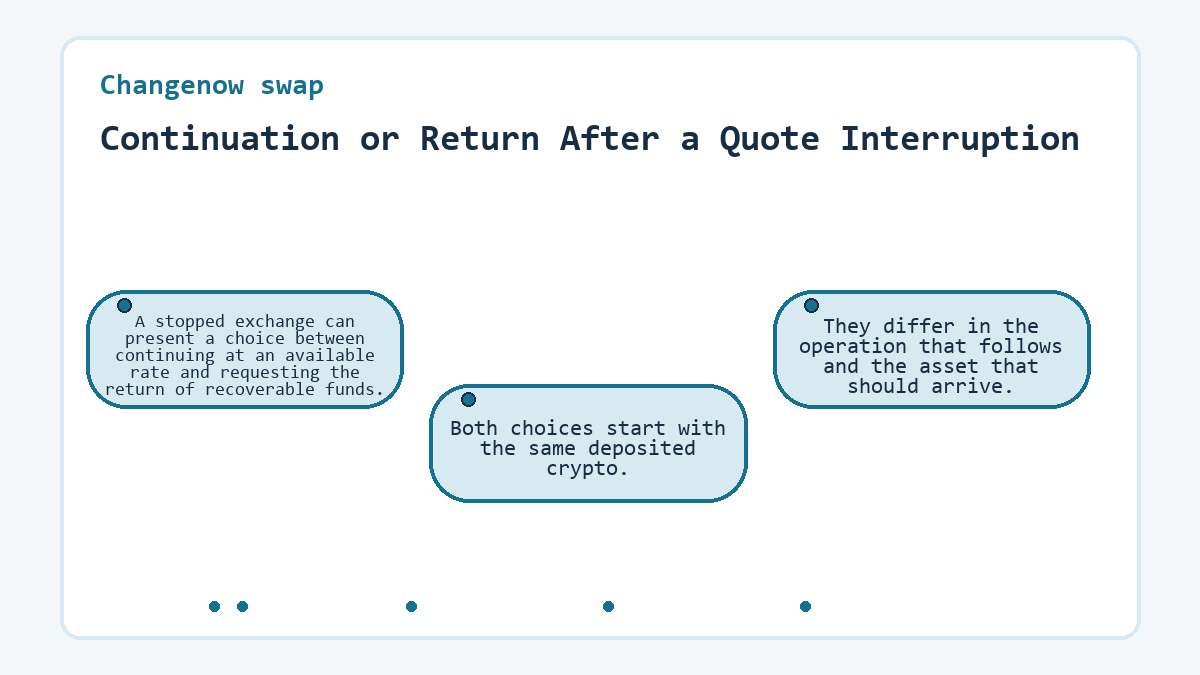
A stopped exchange can present a choice between continuing at an available rate and requesting the return of recoverable funds. Both choices start with the same deposited crypto. They differ in the operation that follows and the asset that should arrive.
Continuation authorizes the offered exchange outcome. A refund request seeks a return instead, subject to eligibility and deductions. The available rate changes with market conditions; the distinction between conversion and return remains the same. Where support offers both options, use the order-specific terms to make the choice.
- If no deposit has left the wallet, leave the unwanted order unfunded.
- If support offers continuation, review the revised output before accepting it.
- If support offers a refund, confirm the recoverable asset and permitted destination.
- If conversion is partial, clarify which portion will return and which will pay out.
- If support reports a transfer, match its hash, destination, and amount to the agreed outcome.
For continuation, completion means receiving the agreed output. For a refund, it means receiving the agreed return. A support acknowledgment alone establishes neither outcome.
Refund Deductions and Recovery Time
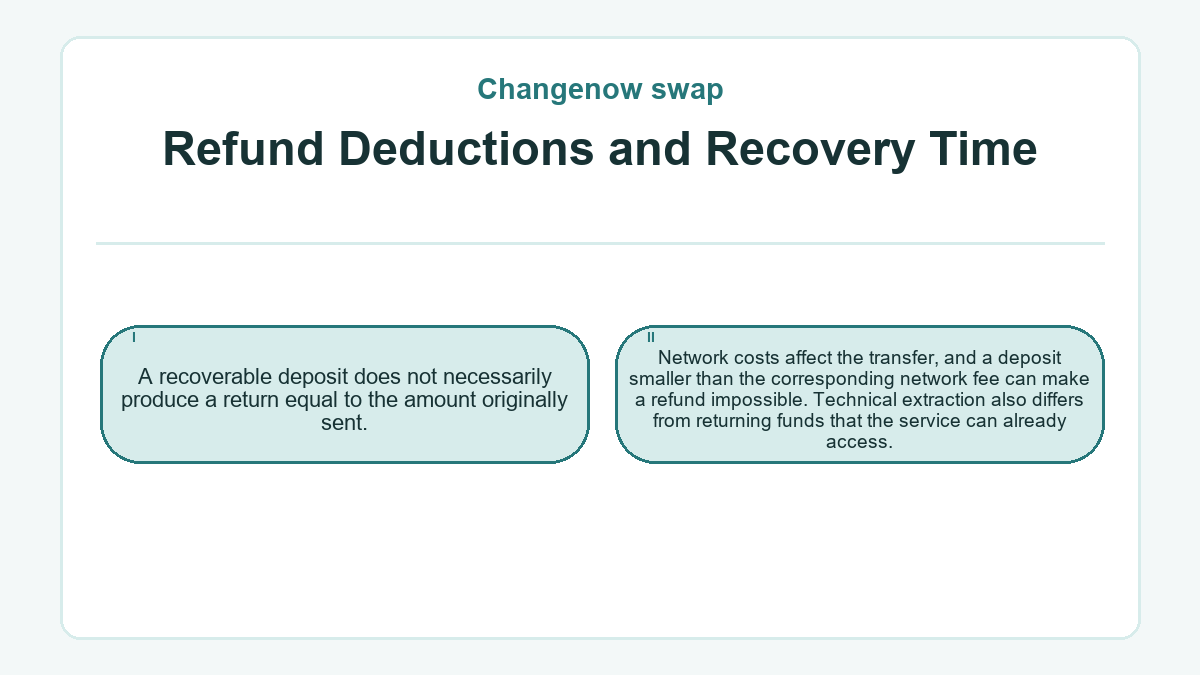
A recoverable deposit does not necessarily produce a return equal to the amount originally sent. Network costs affect the transfer, and a deposit smaller than the corresponding network fee can make a refund impossible. Technical extraction also differs from returning funds that the service can already access.
Digital asset extraction can take up to 20 business days. That extraction window is not a universal refund deadline. Deposit mistakes can also attract a separate recovery charge, apart from network costs. Ask support to distinguish the recoverable balance, deductions, and any additional payment before agreeing to recovery.
Compliance Holds and Release Conditions
A compliance review introduces a separate release condition even when conversion has not finished. Refusing Know Your Customer verification can lead to a refund in eligible cases, but it does not guarantee release. An investigation involving suspected illegal activity can prevent an ordinary refund, with authorized-body requirements affecting the outcome. A request to cancel does not remove those restrictions.
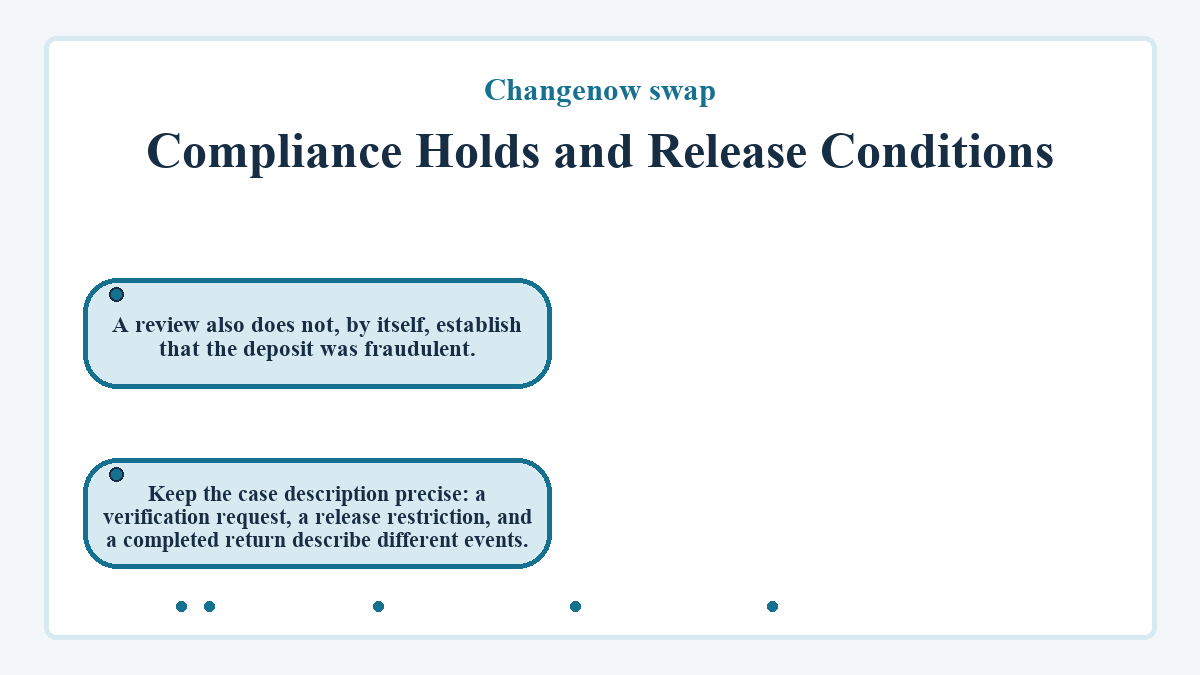
A review also does not, by itself, establish that the deposit was fraudulent. Keep the case description precise: a verification request, a release restriction, and a completed return describe different events.
Changenow swap: quick answers
Does Closing the Exchange Window Cancel a Funded Order?
Closing the exchange window does not stop processing. Browser history can help recover the status page if you lose it. Closing the window therefore does not substitute for a refund request.
What Happens to My Refund Records If I Delete the Mobile App?
Deleting the ChangeNOW exchange app removes the exchange history stored on that device. Save the exchange ID and relevant transaction hashes before removing it, especially while a refund remains unresolved. Losing local history does not erase the blockchain transfers.
Can Support Reverse a Refund After It Reaches the Blockchain?
A confirmed refund transfer cannot simply be reversed through a support request. The return is itself a blockchain transaction, so its destination matters just as much as the original deposit destination. Review the permitted return address before the service sends it.
Is a Private Key Necessary to Prove a Refund Claim?
Support does not need your wallet's private key to handle a refund claim. Keep private keys secret, including when someone claims they need one to release funds. Transaction records can identify transfers without giving another person control of the wallet.
Why Does a Deposit Awaiting Confirmations Not Guarantee an Immediate Refund?
A confirmation stage means the network is still processing the deposit. It does not establish that support has approved a return or that the service has sent one. The service cannot accelerate network confirmation itself. Refund eligibility still requires a separate assessment.